It’s a statement of the obvious to say that public sentiment around data centers is negative, and one of the reasons is a fear that higher demand will push electricity bills higher. But most of the power system in the U.S. operates on a cost-plus regulatory pricing scheme and about 80% of the power system’s cost are fixed[1], i.e., they don’t vary with the level of consumption. That means the bulk of per kilowatt hour prices are set by dividing total costs by total usage, so if system-wide usage rises and data centers are forced to contribute to these existing fixed costs, not just the incremental costs they incur, residential prices can actually decline.
These fixed costs are comprised of capital recovery[2] and sales, and general and administrative costs (SG&A) or “overhead.” This overhead varies by state depending on that state’s cost of living index[3] and whether power generation operates under a competitive system with prices being set by supply and demand, or a vertically integrated cost-plus regulated utility model. In all states, the poles/wires/transformers are a cost-plus system and on average, that cost accounts for about 11-12 cents of the 18 cents per kilowatt hour paid by the average residential customer.[4]
Since cost reductions can only affect current operating expenses (and not past capital expenditures), and these days, are nearly impossible in an inflationary environment, the best way to actually reduce residential costs is to increase the kilowatt hours those system costs are being divided by to derive the per kilowatt hour charge.
Numerator, denominator. Third-grade arithmetic.
That brings us back to data centers which along with industry re-shoring, offer the first significant opportunity to materially grow the denominator since the decades after World War II. And while everyone seems to think that more usage can only increase costs, shrinking usage would be worse. That’s what nearly happened in the 1980s when the whole system in the U.S. was a cost-plus vertically integrated utility model regulated at the state level. Massive cost overruns for nuclear plants (averaging three times the original budget, and more than ten times at the worst) in a cost-plus system made everyone’s electric bills go up.[5] Large industrial users found they could make their own electricity for less[6] and were planning on cutting the cord and self-generating. That would have made everyone’s cost go up even more as the denominator shrank. Then it would be economic for medium-sized industrial users to self-generate and a negative feedback loop was in the making.
This risk prompted the federal government to establish the first competitive markets for power generation and establish open access rules that would allow an independent power producer to freely access customers via a grid controlled by a monopoly competitor. After these laws were implemented at the federal level, it was left to the states to determine if the legacy utilities (which were all operating under state regulation) would be able to keep their power generation assets in the cost-plus model. 35 states elected to do so and 15 elected to separate those assets from the utility and force them to compete solely on price. And, on the basis of price, these policies were an overwhelming success because they – along with other energy industry deregulation – resulted in a 60-70% decline in inflation-adjusted wholesale power prices per kilowatt hour.[7]
We now stand to benefit from the exact opposite situation, especially in the 35 vertically integrated, cost-plus regulated states that account for 58% of U.S. power demand.[8]
Exhibit A: In Louisiana, a vertically integrated state whose utility is Entergy Corp., Meta’s Hyperion data center campus in Richland Parish will likely increase the state’s power demand by 35-60% and will actually lower residential costs per kilowatt hour as those fixed costs are spread across a much larger denominator[9].
Exhibit B: Entergy’s Mississippi utility customers will enjoy $2 billion of savings over 20 years from its contracts with Amazon for data centers in that state[10].
Exhibit C: AES (a multi-state utility) came up with this graph to illustrate this point for their operations in vertically integrated Indiana:
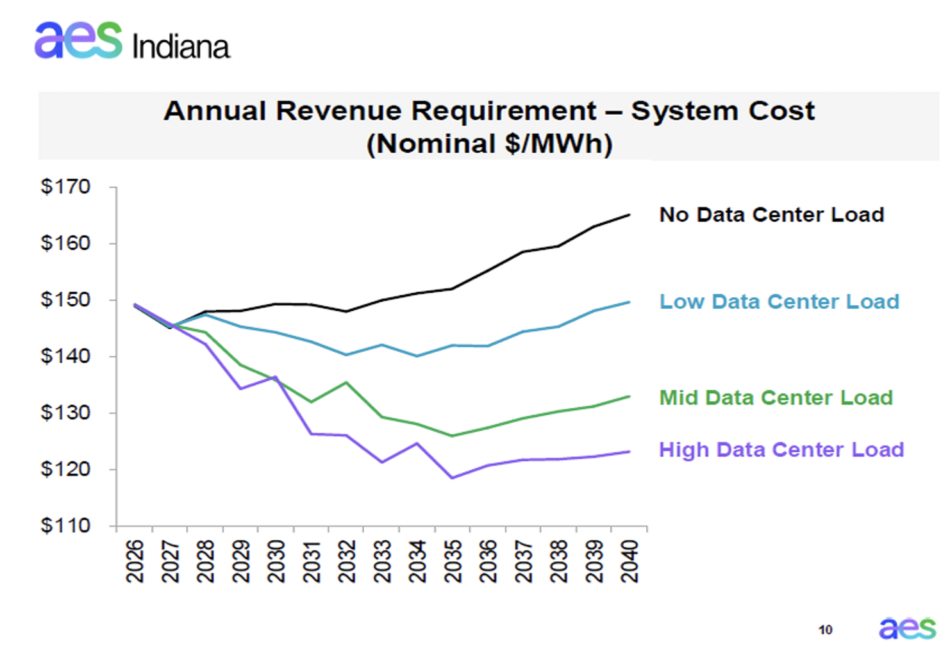 Source: AES Third Quarter 2025 Financial Review 11-5-25, page 10. This information is presented as an example. This is not a recommendation to buy or sell a particular security.
Additional anecdotes include Duke Power’s calculation that in North Carolina each 1 GW of demand added by a data center would lower customer bills by $1 billion over 15 years because as the Duke CEO said, the contracts are designed so that the data center “…covers its expenses and then some.”[11] And finally, American Electric Power’s Kentucky Power subsidiary stated, customers will receive $500 million of fixed-cost offsets in addition to other credits related to the development of a 1 GW data center campus. [12]
In short, the benefit derives from fixed cost contribution in the rates paid by the new industrial customer.
In the other 15 states where the power generation is provided by independent power producers (not vertically integrated utilities that use a cost-plus revenue model) and wholesale power prices are set by supply and demand, those prices are, naturally, rising as demand outpaces supply for the first time in 20 years (Power Struggle II). This is the opposite of what happened when demand was flat for those 20 years while capacity grew and wholesale prices were falling. But the other 60% of the residential bill that pays for transmission and distribution (the last mile of wires) is a cost-plus regulated monopoly model with the same numerator-denominator arithmetic.
So, when policy makers, pundits or even some utility CEOs speak about data centers paying their “fair share”, what is missing is that “fair” must mean that the legacy costs and overhead will be part of what they pay. Requiring data centers to pay only “the costs they incur”, (as in the White House’s Ratepayer Protection Pledge) leaves out this necessary contribution to existing overhead costs. It is those costs that support a grid with the scale and inertia to provide critical voltage and frequency stability (and other ancillary services[13]) even when large industrial customers change their usage in a matter of seconds, as when an AI training cycle pauses or restarts. This is why most hyper-scalers say that their behind-the-meter self-generation plans are temporary and that when baseload power capacity catches up, they will switch to grid power. This grid stability is a service the state’s ratepayers spent decades and billions of dollars building, and it should not be given away for free.
This is also why islanding data centers on to their own “micro- or mini-grids” isn’t necessarily the answer either. In those competitive states, adding capacity is the only way to get the wholesale market supply-and-demand pricing dynamic to lower prices that have risen from existing demand. But while islanding that new supply may dampen the price effect of rapid demand growth in competitive states, it forfeits the benefits of a shared network. Shared networks provide the benefit of reliability that comes from diverse supply sources, open and transparent price discovery and the ability of customers and suppliers to optimize their commercial activities. This isn’t unique to electric power networks and has been observable for centuries. See for example: The Age of Discovery, canals, railroads, highway systems, telecommunications systems, the internet, etc.
To state-level policymakers, consumer advocates and utility CEOs who are listening: the best way to secure the economic benefits of attracting large industrial users to your state, be they data centers or otherwise, is to take advantage of this opportunity to spread the grid’s overhead costs over more kilowatt hours and actually lower residential power prices. To be sure, many communities don’t want data centers as neighbors, but others, like Richland Parish, Louisiana or Harwood, North Dakota[14], may welcome the economic and property and sales tax benefits they provide. This dynamic has played out over the years in the siting of prisons, nuclear power plants, gambling casinos, etc. Allowing those communities to make the decision will benefit them and everyone else in the state because of the arithmetic of a larger denominator.
Why does an infrastructure investor care? Because the businesses we own earn a regulated return on what they build, and they can keep building only while the public at large benefits. States that make new industrial customers contribute to the costs that support the grid stability that attracts them to grid power rather than self-generation will get lower rates and healthier utilities. Oh, and that benefits the public as well. Third grade ethics.
[1] EIA and EIP estimates
[2] Capital costs are recovered because depreciation, interest on debt, and an allowed return on equity are passed along with operating costs.
[3] See Power Struggle I
[4] IBID
[5] Bruce Biewald, “Energy planning in response to climate change: Accurate costs are critical,” Bulletin of the Atomic Scientists, July 13, 2011, https://thebulletin.org/2011/07/energy-planning-in-response-to-climate-change-accurate-costs-are-critical/
[6] I have personal experience with this. In the mid-1980s I was head of Business Development for refining and marketing for BP in the U.S. and our two largest refineries, the largest industrial customers in the state of Ohio were paying about 6 cents per kilowatt hour. We could self-generate it for about 3 cents per kilowatt hour assuming then current natural gas prices of about $1.50 per MCF.
[7] Wholesale prices in the mid-1980s were about 6 cents per kilowatt hour, (Source: EIA) adjusted for inflation that is 19.5 cents in 2026 dollars. The average 7 cents per KWH today is approximately a 64% decline in real terms.
[8] EIA as of December 29,2025
[9] Entergy, EIA, Meta. The Hyperion campus is now slated to by 5 GW but could be much larger.
[10] “Who Pays for the Wires? How Six States Structured Their Data Center Deals” by Arizona Data Center Alliance 8-11-26
[11] Latitude Media quote of Duke CEO Harry Sidaris from CERA Week March 27, 2026. https://www.latitudemedia.com/news/the-tech-utility-pr-blitz-data-centers-can-lower-energy-costs/
[12] Source: American Electric Power news release 11-13-26 https://www.aep.com/news/stories/view/12385/
[13] Ancillary services also include Operating Reserves, Black Start Capability and Energy Imbalance/Load Following – Source: Federal Energy Regulatory Commission.
[14] Richland Parish is the site of Meta’s Hyperion Data Center. Wall Street Journal, 11-13-26 “The North Dakota Town Where Data Centers Won”
Disclosure:
The information above is EIP’s opinion which may change at any time without the duty to update or notify. Information provided is believed to be accurate as of the date on the materials. EIP reserves the right to update, modify or change information without notice. The information is based on data obtained from third party publicly available sources that EIP believes to be reliable, but EIP has not independently verified and cannot warrant the accuracy of such information. Information regarding any company is provided as an example and is not intended as a recommendation to buy or sell a particular security, company or industry. Certain information contained herein may constitute forward-looking statements. Due to various risks and uncertainties, actual events, results or the performance of the strategy may differ materially from those reflected or contemplated in such forward-looking statements.